You weren't taught how to run groups. This training will change that.
Group Therapy 101 is a foundational CE workshop for clinicians who want to facilitate powerful, ethical, and inclusive therapy groups — with the confidence to handle whatever comes up in the room.
Does this sound familiar?
You graduated with barely any group therapy training — and now you're expected to facilitate one
You know groups are effective, but you're not sure how to actually structure one, set agreements, or handle conflict
You want to start a group in private practice — but you don't know where to begin or how to make it feel safe for everyone
You've run groups before, but imposter syndrome has you wondering if you're doing it "right"
What you'll learn
This isn't a lecture you sit through to collect CEs. It's a working session. You'll leave with frameworks you can apply immediately, language you can use in your next group, and a felt sense of what it's like to be in the room — through a live experiential component.
The key differences between process, psychoeducational, skills-based, and peer support groups — and when to use each
How groups develop over time — and what to do at each stage, from first session to termination
How to create safety, structure, and cohesion — especially for members who've never been in a group before
What to say when a member dominates, someone goes silent, or conflict erupts — with real example language
How to center diversity, equity, and inclusion in your group design, agreements, and facilitation — not as an add-on, but as a foundation
Group ethics and confidentiality — the complexities unique to group work that your grad program probably didn't cover
How to run effective groups on Zoom — presence, confidentiality logistics, and engagement on a screen
How to start a group in private practice — from filling it to running your first session
This training is for you if you are an...
Early-career clinician who wants a stronger foundation before running your first group
Private practice therapist who is ready to add groups to your caseload
Agency or IOP clinician who is running groups without any formal training in facilitation
Experienced therapist who wants to sharpen your skills and get CE credits
About Your Trainer:
Maggie Malone, LCSW (she/her) is a licensed clinical social worker and the founder of Rosebud Psychotherapy in Marietta, GA. She has facilitated groups across levels of care — residential, PHP, IOP, and outpatient — and currently runs multiple therapy groups in her private practice, including a DBT skills group, a women's process group, a Dungeons and Dragons Therapy group, and a therapeutic book club.
Maggie is the Vice President and President Elect of the Atlanta Group Psychotherapy Society (AGPS) and studied at Smith College and the University of Georgia. She has over 100 hours of post-grad training in group therapy. She is passionate about educating clinicians and clients about the power and efficacy of groups.
The Details:
Date: Friday, May 22, 2026
Time: 11:00 AM – 1:00 PM EST
Format: Live and virtual via Zoom
CE credit: 2 Core CEs (GSCSW approved)
Capacity: Limited to 25 participants
Includes: Resource guide PDF + certificate
This training is designed as a foundational introduction to group therapy and may serve as a starting point for clinicians interested in further education and training in group facilitation.
*If you are a student or are experiencing financial hardship, you can reach out to mmalone@rosebudpsychotherapy.com for a discounted rate.
You weren't taught how to run groups. This training will change that.
Group Therapy 101 is a foundational CE workshop for clinicians who want to facilitate powerful, ethical, and inclusive therapy groups — with the confidence to handle whatever comes up in the room.
Does this sound familiar?
You graduated with barely any group therapy training — and now you're expected to facilitate one
You know groups are effective, but you're not sure how to actually structure one, set agreements, or handle conflict
You want to start a group in private practice — but you don't know where to begin or how to make it feel safe for everyone
You've run groups before, but imposter syndrome has you wondering if you're doing it "right"
What you'll learn
This isn't a lecture you sit through to collect CEs. It's a working session. You'll leave with frameworks you can apply immediately, language you can use in your next group, and a felt sense of what it's like to be in the room — through a live experiential component.
The key differences between process, psychoeducational, skills-based, and peer support groups — and when to use each
How groups develop over time — and what to do at each stage, from first session to termination
How to create safety, structure, and cohesion — especially for members who've never been in a group before
What to say when a member dominates, someone goes silent, or conflict erupts — with real example language
How to center diversity, equity, and inclusion in your group design, agreements, and facilitation — not as an add-on, but as a foundation
Group ethics and confidentiality — the complexities unique to group work that your grad program probably didn't cover
How to run effective groups on Zoom — presence, confidentiality logistics, and engagement on a screen
How to start a group in private practice — from filling it to running your first session
This training is for you if you are an...
Early-career clinician who wants a stronger foundation before running your first group
Private practice therapist who is ready to add groups to your caseload
Agency or IOP clinician who is running groups without any formal training in facilitation
Experienced therapist who wants to sharpen your skills and get CE credits
About Your Trainer:
Maggie Malone, LCSW (she/her) is a licensed clinical social worker and the founder of Rosebud Psychotherapy in Marietta, GA. She has facilitated groups across levels of care — residential, PHP, IOP, and outpatient — and currently runs multiple therapy groups in her private practice, including a DBT skills group, a women's process group, a Dungeons and Dragons Therapy group, and a therapeutic book club.
Maggie is the Vice President and President Elect of the Atlanta Group Psychotherapy Society (AGPS) and studied at Smith College and the University of Georgia. She has over 100 hours of post-grad training in group therapy. She is passionate about educating clinicians and clients about the power and efficacy of groups.
The Details:
Date: Friday, May 22, 2026
Time: 11:00 AM – 1:00 PM EST
Format: Live and virtual via Zoom
CE credit: 2 Core CEs (GSCSW approved)
Capacity: Limited to 25 participants
Includes: Resource guide PDF + certificate
This training is designed as a foundational introduction to group therapy and may serve as a starting point for clinicians interested in further education and training in group facilitation.
*If you are a student or are experiencing financial hardship, you can reach out to mmalone@rosebudpsychotherapy.com for a discounted rate.

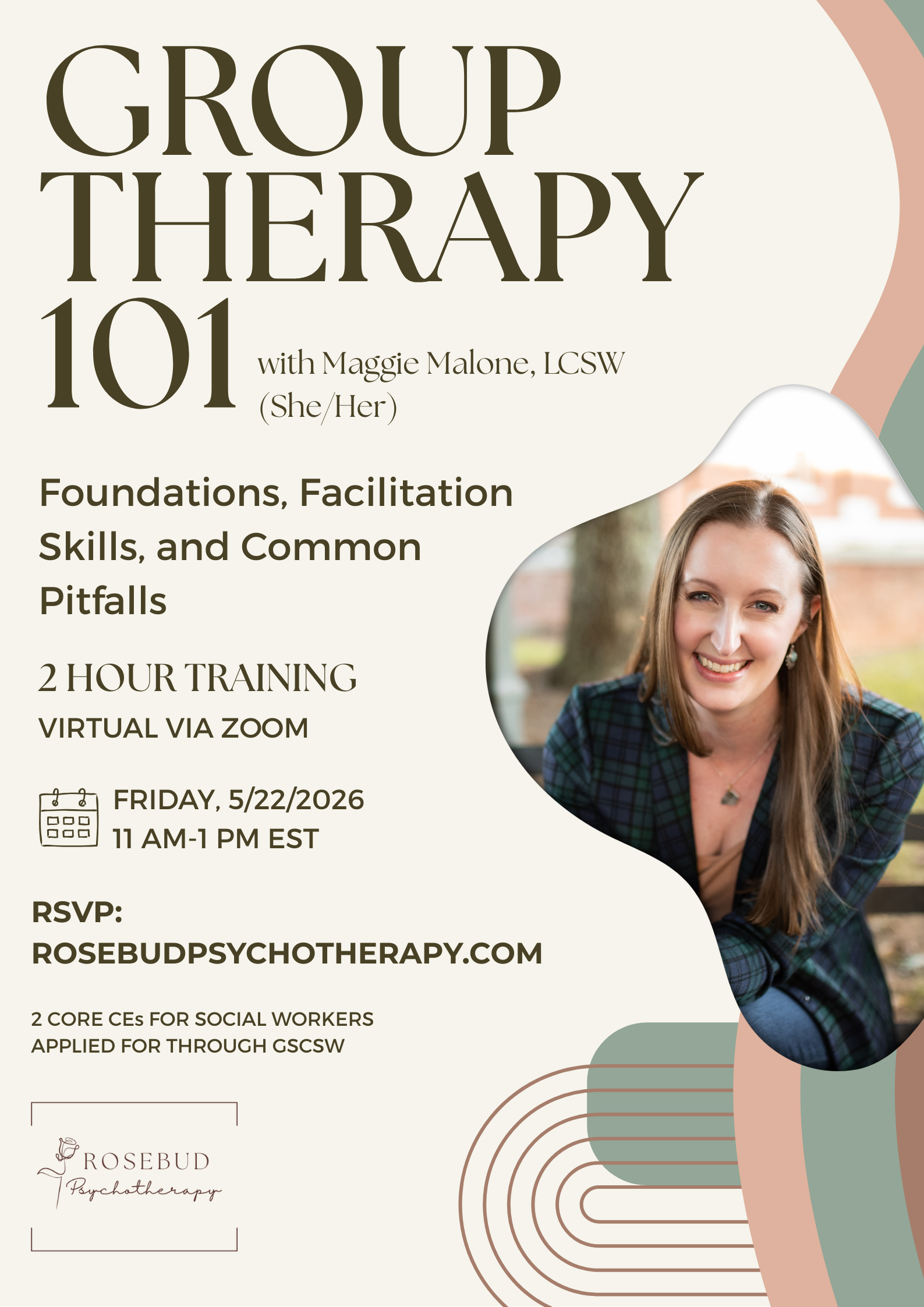 Image 1 of 1